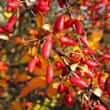
- Barberry has been used in Indian folk medicine for centuries, and the Chinese have used berberine, a constituent of barberry, since ancient times. The first available documented use of berberine was in 1933 for trachoma (infectious eye disease).
- Historically, barberry was commonly used for its antidiarrheal and antibiotic properties. Barberry is considered tonic, purgative, and antiseptic. As a bitter stomachic tonic, it proves an excellent remedy for dyspepsia and functional derangement of the liver, regulating the digestive powers, and if given in larger doses, acting as a mild purgative and removing constipation. Traditionally, it is used in cases of jaundice, general debility and biliousness (gastric distress), and for diarrhea.
- Of most interest throughout history is berberine, an alkaloid found in barberry as well as goldenseal, tree turmeric and Oregon grape. The use of berberine is most commonly used for the management of diarrhea related to cholera and for the treatment of trachomas.
- Berberine has promising anti-inflammatory, antineoplastic (anti-cancer), hypoglycemic (blood sugar lowering), and immunomodulating effects. Current investigations into berberine continue. However, the use of barberry as a whole plant has been left relatively unexplored.

← Back to Monographs
 ingredients
Barberry
Contents
- Chung JG, Wu LT, Chang SH, et al. Inhibitory actions of berberine on growth and arylamine N-acetyltransferase activity in strains of Helicobacter Pylori from peptic ulcer patients. International Journal of Toxicology 1999;18:35.
- Ckless K, Schlottfeldt JL, Pasqual M, et al. Inhibition of in-vitro lymphocyte transformation by the isoquinoline alkaloid berberine. J Pharm Pharmacol. 1995;47(12A):1029-1031.
View Abstract - Di DL, Liu YW, Ma ZG, et al. [Determination of four alkaloids in Berberis plants by HPLC]. Zhongguo Zhong.Yao Za Zhi. 2003;28(12):1132-1134.
View Abstract - Fatehi M, Saleh TM, Fatehi-Hassanabad Z, et al. A pharmacological study on Berberis vulgaris fruit extract. J Ethnopharmacol 10-31-2005;102(1):46-52.
View Abstract - Fatehi-Hassanabad Z, Jafarzadeh M, Tarhini A, et al. The antihypertensive and vasodilator effects of aqueous extract from Berberis vulgaris fruit on hypertensive rats. Phytother Res 2005;19(3):222-225.
View Abstract - Freile ML, Giannini F, Pucci G, et al. Antimicrobial activity of aqueous extracts and of berberine isolated from Berberis heterophylla. Fitoterapia 2003;74(7-8):702-705.
View Abstract - Fukuda K, Hibiya Y, Mutoh M, et al. Inhibition by berberine of cyclooxygenase-2 transcriptional activity in human colon cancer cells. J Ethnopharmacol. 1999;66(2):227-233.
View Abstract - Haupt H. [Poisonous and less poisonous plants. 63. Barberry (Berberidaceae) (Berberis vulgaris)]. Kinderkrankenschwester. 2003;22(12):538-539.
View Abstract - Khosla PK, Neeraj VI, Gupta SK, et al. Berberine, a potential drug for trachoma. Rev Int Trach.Pathol Ocul Trop Subtrop Sante Publique 1992;69:147-165.
View Abstract - Kostalova D, Bukovsky M, Koscova H, et al. [Anticomplement activity of Mahonia aquifolium bisbenzylisoquinoline alkaloids and berberine extract]. Ceska Slov.Farm. 2001;50(6):286-289.
View Abstract - Mahajan VM, Sharma A, Rattan A. Antimycotic activity of berberine sulphate: an alkaloid from an Indian medicinal herb. Sabouraudia 1982;20:79-81.
- Pozniakovskii VM, Golub OV, Popova DG, et al. [The use of barberry berries in human nutrition]. Vopr.Pitan. 2003;72(4):46-49.
View Abstract - Rabbani GH, Butler T, Knight J, et al. Randomized controlled trial of berberine sulfate therapy for diarrhea due to enterotoxigenic Escherichia coli and Vibrio cholerae. J Infect.Dis 1987;155(5):979-984.
View Abstract - Sack, R. B. and Froehlich, J. L. Berberine inhibits intestinal secretory response of Vibrio cholerae and Escherichia coli enterotoxins. Infect Immun. 1982;35(2):471-475.
View Abstract - Shamsa F, Ahmadiani A, Khosrokhavar R. Antihistaminic and anticholinergic activity of barberry fruit (Berberis vulgaris) in the guinea-pig ileum. J Ethnopharmacol 1999;64(2):161-166.
View Abstract
Disclaimer: This tool is intended for informational purposes only, and should not be interpreted as specific medical advice. Patients should consult with a qualified healthcare provider before making decisions about therapies and/or health conditions.