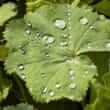
- Ladies mantle was named in the 16 century by Jerome Bock, also known as Tragus, and it appears under his name in the book History of Plants, published in 1532. Ladies mantle is referred to as lady's cloak or mantle because of its association with the Virgin Mary. The lobes of the leaf are said to resemble the scalloped edges of a mantle. It has also been referred to as lion's foot and bear's foot, most likely because of the resemblance of its spreading root leaves to such feet.
- Ladies mantle has been used for many centuries in Europe including in Sweden and Germany. Some experts consider ladies mantle to be good for treating wounds due to its coagulation (blood clotting), astringent and styptic (stops bleeding) properties. It has also been used as a mouth rinse after dental procedures to help stop bleeding. Ladies mantle has been used for a variety of female conditions such as menstrual disorders including excessive menstruation and menopause, as an aid during conception, in the prevention of miscarriages, and to help the body heal after childbirth. However, clinical data is lacking.

← Back to Monographs
 ingredients
Ladies mantle (Alchemilla vulgaris)
Contents
- Fraisse D, Carnat A, Carnat AP, et al. [Standardization of the aerial parts of Alchemilla]. Ann.Pharm Fr. 1999;57(5):401-405.
View Abstract - Nihoul-Ghenne L. [Presence of Alchemilla alpina L. together with Alchemilla vulgaris L. in a tea for high blood pressure.]. J Pharm Belg. 1950;5(11-12):335-338.
View Abstract - Schimmer O, Hafele F, Kruger A. The mutagenic potencies of plant extracts containing quercetin in Salmonella typhimurium TA98 and TA100. Mutat.Res 1988;206(2):201-208.
View Abstract - Schimmer O, Kruger A, Paulini H, et al. An evaluation of 55 commercial plant extracts in the Ames mutagenicity test. Pharmazie 1994;49(6):448-451.
View Abstract - Swanston-Flatt SK, Day C, Bailey CJ, et al. Traditional plant treatments for diabetes. Studies in normal and streptozotocin diabetic mice. Diabetologia 1990;33(8):462-464.
View Abstract
Disclaimer: This tool is intended for informational purposes only, and should not be interpreted as specific medical advice. Patients should consult with a qualified healthcare provider before making decisions about therapies and/or health conditions.