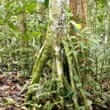
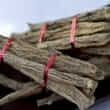
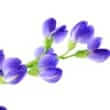
- Wild indigo (Baptisia australis) has deep blue to violet flowers, similar to sweet pea flowers. When the plant's sap is exposed to air, it turns purple. Although this sap has been used for dying, it is not as colorfast as true indigo (Indigofera tinctoria). Some Native Americans tribes used a tea of blue indigo root as an emetic (induces vomit) and purgative.
- Wild indigo is considered toxic and is on the U. S. Food and Drug Administration's (FDA) list of toxic plants. However, two studies in humans found no adverse effects when it was used in a combination of Baptisiae tinctoriae radix, Echinaceae pallidae/purpureae radix, and Thujae occidentalis herba. Currently, wild indigo seems most promising as an immunomodulator, as both laboratory studies and clinical studies using combination products have noted some benefit. However, more studies are needed using wild indigo as a monotherapy before its safety and efficacy can be determined.

← Back to Monographs
 ingredients
Wild indigo (Baptisia australis)
Contents
- Beuscher N, Kopanski L. [Stimulation of immunity by the contents of Baptisia tinctoria]. Planta Med 1985;(5):381-384.
View Abstract - Beuscher N, Scheit KH, Bodinet C, et al. [Immunologically active glycoproteins of Baptisia tinctoria]. Planta Med 1989;55(4):358-363.
View Abstract - Dowlatshahi K, Jokich PM, Schmidt R, et al. Cytologic diagnosis of occult breast lesions using stereotaxic needle aspiration. A preliminary report. Arch Surg 1987;122(11):1343-1346.
View Abstract - Ikeda T, Jinno H, Fujii H, et al. Recent development of sentinel lymph node biopsy for breast cancer in Japan. Asian J Surg 2004;27(4):275-278.
View Abstract - Imoto S, Fukukita H, Murakami K, et al. Pilot study on sentinel node biopsy in breast cancer. J Surg Oncol 2000;73(3):130-133.
View Abstract - Kohler G, Bodinet C, Freudenstein J. [Pharmacodynamic effects and clinical effectiveness of a combination of herbal substances comprised of Cone Flower, Wild Indigo and White Cedar]. Wien.Med Wochenschr. 2002;152(15-16):393-397.
View Abstract - Naser B, Lund B, Henneicke-von Zepelin HH, et al. A randomized, double-blind, placebo-controlled, clinical dose-response trial of an extract of Baptisia, Echinacea and Thuja for the treatment of patients with common cold. Phytomedicine 2005;12(10):715-722.
View Abstract - Ragosch V, Hundertmark S, Hopp H, et al. [Insulin-like-growth-factor-binding-protein 1 (IGFBP-1) and fetal fibronectin in diagnosis of premature rupture of fetal membranes]. Geburtshilfe Frauenheilkd. 1996;56(6):291-296.
View Abstract - Wack M, Classen B, Blaschek W. An acidic arabinogalactan-protein from the roots of Baptisia tinctoria. Planta Med 2005;71(9):814-818.
View Abstract - Wagner H, Jurcic K. [Immunologic studies of plant combination preparations. In-vitro and in-vivo studies on the stimulation of phagocytosis]. Arzneimittelforschung. 1991;41(10):1072-1076.
View Abstract - Wagner H, Proksch A, Riess-Maurer I, et al. [Immunostimulating action of polysaccharides (heteroglycans) from higher plants]. Arzneimittelforschung. 1985;35(7):1069-1075.
View Abstract - Wagner H, Proksch A, Riess-Maurer I, et al. [Immunostimulant action of polysaccharides (heteroglycans) from higher plants. Preliminary communication]. Arzneimittelforschung. 1984;34(6):659-661.
View Abstract - Wustenberg P, Henneicke-von Zepelin HH, Kohler G, et al. Efficacy and mode of action of an immunomodulator herbal preparation containing Echinacea, wild indigo, and white cedar. Adv.Ther. 1999;16(1):51-70.
View Abstract
Disclaimer: This tool is intended for informational purposes only, and should not be interpreted as specific medical advice. Patients should consult with a qualified healthcare provider before making decisions about therapies and/or health conditions.